
Why is my retaining wall leaning? Causes and fixes in North Texas
By the Premier 1 crew · · updated
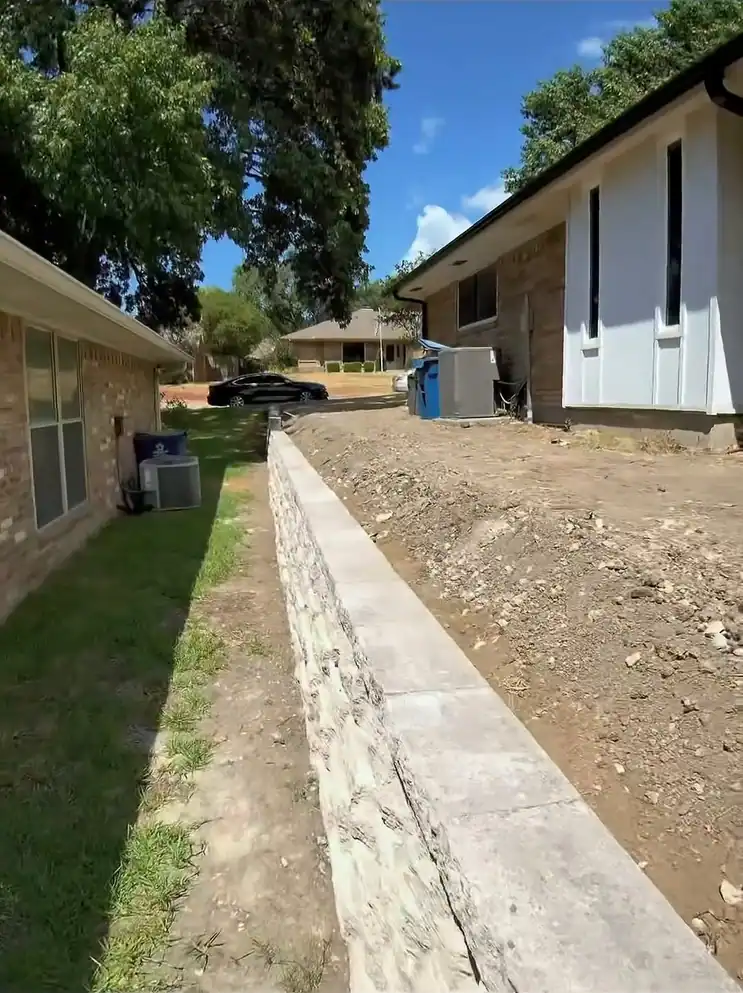
Short answer: most leaning retaining walls in North Texas are being pushed by water. Clay soil behind the wall soaks up rain, swells, and has nowhere to drain, so it shoves the wall forward a little more every wet season. The fix is to give that water a way out, usually gravel behind the wall and a French drain at the bottom, and to rebuild any section whose base has moved.
Water always wins an argument with dirt. Our job is to make sure it argues somewhere else.
Why does North Texas soil push walls over?
Much of the Dallas area sits on Blackland Prairie clay. When it's wet it swells, when it's dry it shrinks and cracks, and while it's doing either it holds water instead of letting it through. Behind a retaining wall, that means:
- Hydrostatic pressure. Water trapped in the soil pushes on the back of the wall.
- Swelling. Wet clay expands and adds its own push.
- Washout. Water that does escape often takes soil from under the base with it.
A wall built without drainage is a wall built with a countdown. (We're not saying the countdown is short. We're just saying we've met a lot of walls that thought they had more time.)
What are the warning signs?
Walk your wall after a heavy rain and look for:
- Lean. The top sits further forward than the bottom. Sight down it like you're lining up a putt.
- Bulge. The middle pushes out while the ends stay put.
- Gaps or spilled blocks, especially on the top courses.
- Water or mud at the base that stays long after the rain stopped.
- Soil sinking right behind the wall.
One of these is worth a look. Two or more and it's time to call someone.
Can a leaning wall be repaired?
Sometimes. It depends on the base.
- If the base is sound and only the upper courses have moved, the wall can often be taken down to the good courses and re-stacked. On a Plano job in July 2026, a car had knocked blocks off a wall under a privacy fence; the base was fine, so we re-stacked the wall and reset the fence on new posts.
- If the base has moved or washed out, re-stacking just rebuilds the problem. That section needs a new compacted base, and almost always drainage behind it.
We'll tell you at the estimate which one you've got. A repair that won't last isn't a saving.
How does a French drain help?
A French drain is a trench lined with gravel with a perforated pipe in it. Water in the soil finds the gravel (the easiest path), drops into the pipe, and the pipe carries it to a place it can leave the yard.
Behind a retaining wall, a drain takes away the trapped water that's doing the pushing. In front of a house, it stops rain sheeting toward the foundation. On our Rockwall job in September 2026, the new block retaining wall and the French drains went in as one job, because the yard sloped toward the house and the wall would have been fighting the water from day one.
What should a new wall include?
If you're building new, ask whoever quotes it about:
- The base. A dug, compacted base under the first course, not blocks set on topsoil.
- Drainage gravel behind the blocks.
- A drain or outlet that gives the water a way out of the yard.
- Caps to finish the top.
- Where the water goes next. Moving it off your wall and onto your patio isn't a win.
When should you call?
If your wall is leaning, bulging or dropping blocks, call before the next big storm rather than after. Repairs on a sound base are quicker and cost less than a rebuild.
We build and repair retaining walls and French drains in Rockwall, Plano, Terrell and across North Texas. Call 214-517-1868 or send the quote form for a free estimate. Bring your best putting stance; we'll bring the level.